Disclosure: Use Forever Living is an independent affiliate, not the manufacturer. Links to Forever Living’s official US store on this page are affiliate links, and I may earn a commission if you order through them. Orders are placed and paid for on Forever Living’s checkout. About the author
Aloe vera is one of the most common ingredients in skin care, and one of the most oversold. In cosmetics it works mainly as a water-rich moisturizing base. It is not a sunscreen, it is not a treatment for skin conditions, and the research behind bigger claims is thin. This page explains what aloe does in a skin product, what the evidence does and does not show, and how to pick between a gel, a spray and a lotion.
What “aloe vera” means on a skin-care label
The gel comes from the inner leaf of the plant. It is mostly water, along with sugars and other plant compounds. On an ingredient list it usually appears as Aloe Barbadensis Leaf Juice, often followed by “stabilized aloe vera gel”. Ingredients are listed from largest to smallest amount, so aloe in first or second place means a lot of the formula is aloe-based. The list does not give the percentage.
According to Forever, acemannan is the polysaccharide the International Aloe Science Council (IASC) uses as a marker of quality aloe vera. The IASC is an industry certification body, so its seal tells you about aloe content and processing. It does not tell you what a product will do for your skin.
What the research says
The US National Center for Complementary and Integrative Health (NCCIH) describes topical aloe gel as generally well tolerated, with occasional reports of burning, itching, rash and eczema. It also says there is not enough reliable information to draw conclusions about aloe for skin conditions.
That is the useful frame for shopping: aloe is a well-tolerated moisturizing ingredient for most people, and the claims about skin conditions you see online go further than the evidence. Cosmetics are sold for how skin looks and feels, not to treat a condition.
Three questions people ask
Is aloe vera a sunscreen?
No. UV protection comes from a sunscreen’s active ingredients, not from aloe. Forever’s Aloe Sunscreen is SPF 30, and its US label lists zinc oxide 12%, homosalate 8.5%, octisalate 5% and octocrylene 10% as the actives, with aloe among the inactive ingredients. If you use plain aloe gel after a day outdoors, that is a separate step from protecting your skin before it. See Aloe Sunscreen for Forever’s directions: apply 15 to 30 minutes before sun exposure and reapply at least every 2 hours.
Is aloe a “penetration enhancer”?
This phrase comes from lab research on drug delivery. In an in vitro study (Fox et al., Journal of Pharmacy and Pharmacology, 2015), aloe vera gel increased how much of the test drug ketoprofen passed through excised skin samples compared with a control. A 2010 in vitro study of aloe vera juice (Ballam and Heard, Skin Pharmacology and Physiology) found no such enhancement, so the result depends on the material and the method. These are laboratory experiments on a drug, not on moisturizers. They do not show that aloe makes the other ingredients in a cosmetic work better, and Forever does not make that claim for its products.
Can I use pure aloe gel on my face every day?
Pure aloe gel is a common choice for the face, but a patch test comes first: apply a small amount to the inner forearm and wait 24 hours. Stop if you notice burning, itching or a rash. Do not use it as a substitute for medical care on severe burns, infected skin or wounds.
Gel, spray, lotion or drink: which form fits
| Form | Good for | Forever Living example (US label) |
|---|---|---|
| Gel | Light moisture, a base under or instead of a lotion | Aloe Vera Gelly: aloe, water, glycerin; no fragrance listed, methylparaben listed |
| Toner | Quick refresh with few ingredients | Aloe Activator: over 98% aloe vera gel; five ingredients in total |
| Spray | Re-applying during the day | Aloe First: aloe with propolis extract, allantoin and 11 botanical extracts, 16 fl. oz. |
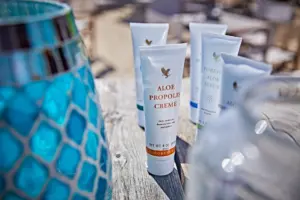
| Lotion or cream | Longer-lasting moisture, face or body | Aloe Moisturizing Lotion, Aloe Propolis Creme |
| Cleanser | Aloe in a wash-off product | Aloe Avocado Face & Body Soap: a bar for face and body, listed by Forever as suitable for all skin types |
| Drink | Not a skin product | Forever Aloe Vera Gel is sold as a drink. Its page does not describe it as a skin product. |
A table of which Forever lotions and creams contain fragrance or parabens is in the Aloe Moisturizing Lotion guide. For a full step-by-step routine, see the hydrating skincare routine.
How to read an aloe product label
- Check the name — “Aloe Barbadensis Leaf Juice” or “aloe vera gel” is the gel. “Aloe extract” or “aloe powder” is a different, usually smaller amount.
- Check the position — near the top means more of the formula; the list never gives a percentage unless the label states one, as Aloe Activator’s does.
- Look at the rest of the list — preservatives and fragrance are normal in water-based products. If you avoid a specific ingredient, read for it by name.
- Treat the seal as a quality signal only — IASC certification relates to the aloe, not to results.
Frequently asked questions
Does drinking aloe vera gel help skin?
Forever’s page for its drinking gel does not make a skin claim, and this site does not either. Treat drinking and topical aloe as separate products with separate purposes.
Who makes these products?
The products above are made by Forever Living Products. For background on the company, see What Is Forever Living Products?. This site is an independent affiliate, so check ingredients and directions on each product’s page before you order.
Forever advises a patch test if you are unsure about sensitivity, and a healthcare professional’s advice during pregnancy. Its skin products are for external use only.
Sources: NCCIH, Aloe Vera; Fox LT et al., J Pharm Pharmacol, 2015 and Ballam L, Heard CM, Skin Pharmacol Physiol, 2010 (in vitro studies with ketoprofen); Forever Living US product pages and ingredient lists.
* These statements have not been evaluated by the Food and Drug Administration. This product is not intended to diagnose, treat, cure, or prevent any disease.
Browse the full range: Forever Living skin care